
Is E-Prescription Legal in India? (2026 NMC + Telemedicine Guidelines)
Yes — e-prescriptions are fully legal in India in 2026. Learn what the NMC and Telemedicine Practice Guidelines 2020 require, what pharmacies accept, and how clinics can issue compliant digital prescriptions.
 Anil KumarHealthcare IT Consultant6 July 2026
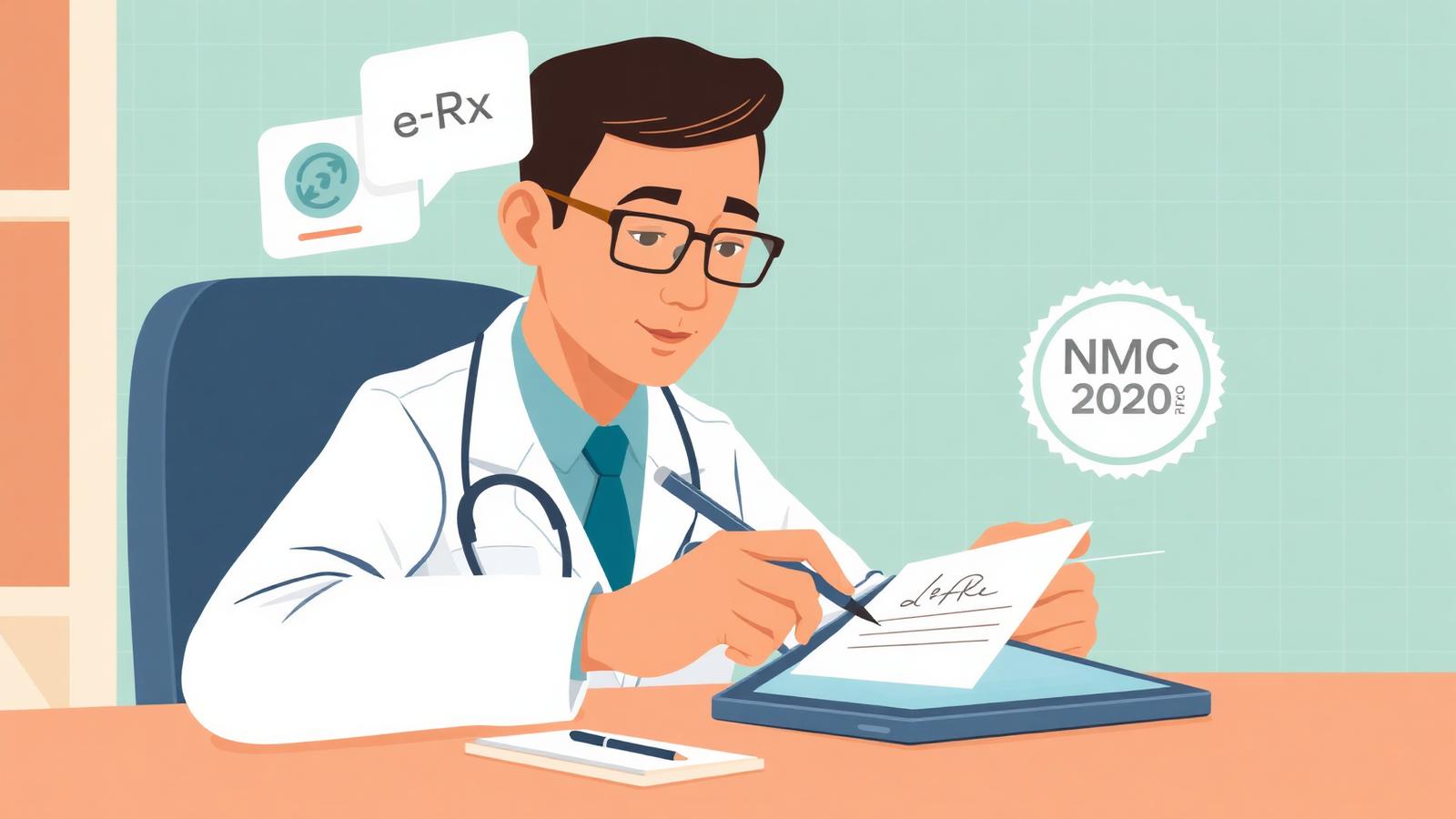
Short answer: Yes — e-prescriptions are fully legal in India in 2026, provided the doctor is registered with the National Medical Commission (NMC) and the prescription follows the Telemedicine Practice Guidelines, 2020 along with the Information Technology Act, 2000. This guide unpacks exactly what makes a digital prescription valid, what pharmacists will accept, and how clinics can start issuing e-prescriptions without any legal risk.
What counts as an "e-prescription" in India?
An e-prescription (also called a digital prescription or electronic prescription) is any medical prescription that is generated, signed and shared electronically — typically as a PDF, an image or a link — instead of on a paper prescription pad. It can be issued during an in-person visit or a teleconsultation, and can be shared via WhatsApp, email, SMS or a patient portal.
Under Indian law, an e-prescription has the same legal standing as a paper prescription as long as it contains all mandatory prescription elements and is issued by a doctor with a valid NMC (formerly MCI) registration.
The three laws that make e-prescriptions legal
1. Telemedicine Practice Guidelines, 2020
Notified by the erstwhile Medical Council of India on 25 March 2020 (and now enforced by the NMC), the Telemedicine Practice Guidelines are the single most important document for e-prescriptions in India. They explicitly permit Registered Medical Practitioners (RMPs) to issue prescriptions during a teleconsultation and lay down what a valid e-prescription must contain.
2. National Medical Commission Act, 2019
The NMC Act made the Telemedicine Guidelines binding on every registered doctor in India. Section 34 empowers the NMC to prescribe standards for professional conduct, and the Registered Medical Practitioner (Professional Conduct) Regulations, 2023 reinforce that digital records and prescriptions are legally recognised.
3. Information Technology Act, 2000 (Sections 4, 5 & 10A)
The IT Act gives electronic records and digital signatures the same legal effect as physical documents. Section 5 specifically recognises digital signatures, which is why an e-prescription with a valid digital signature (or even a scanned signature, per the Telemedicine Guidelines) is enforceable in court and accepted by pharmacies.
What must a valid Indian e-prescription contain?
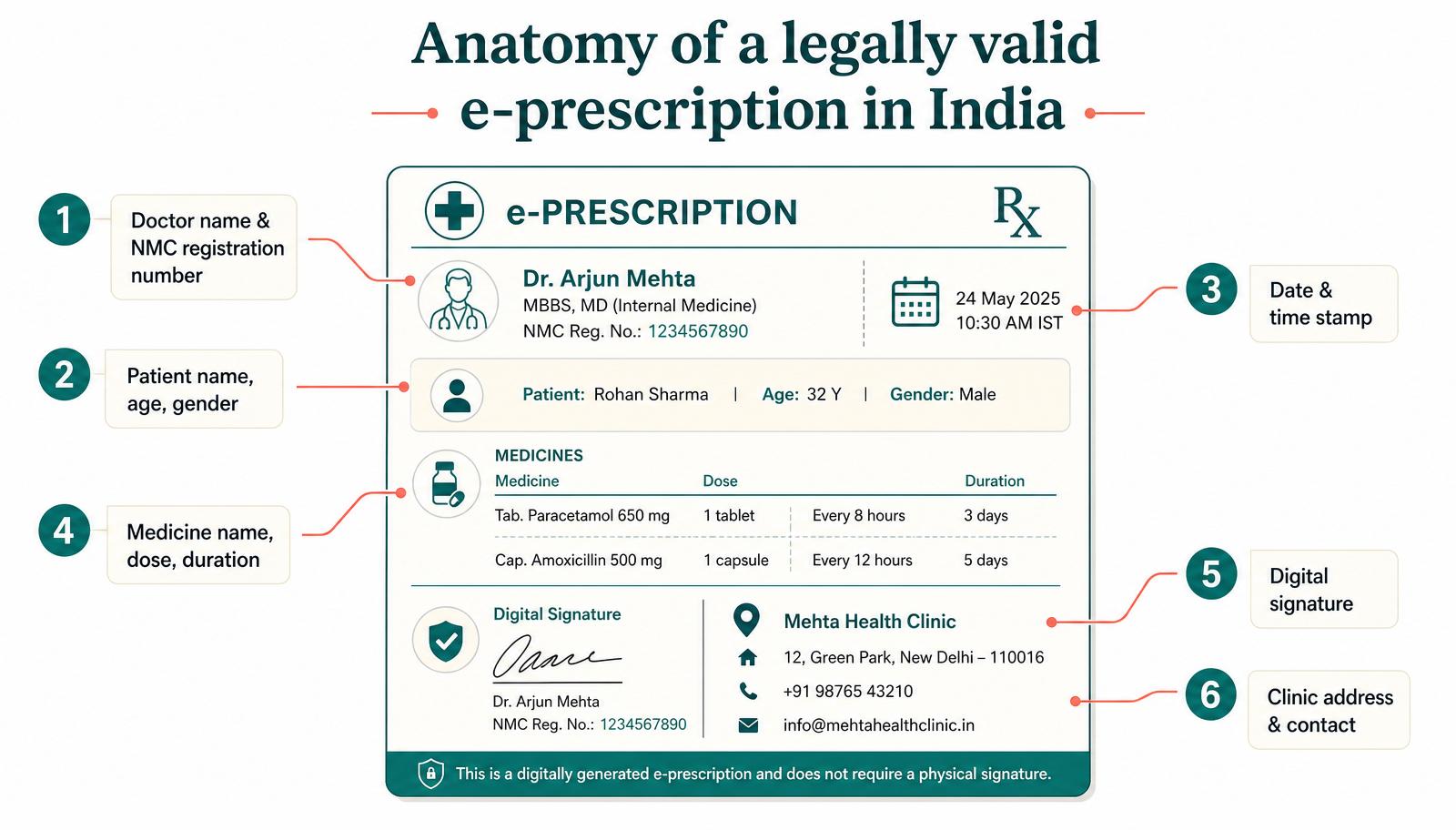
As per Annexure 2 of the Telemedicine Practice Guidelines, an e-prescription is valid only if it includes all of the following:
- Doctor's full name, qualification and NMC registration number
- Patient's name, age and gender
- Date and time of the consultation
- Diagnosis or provisional diagnosis (recommended, not mandatory for every case)
- Medicine name, strength, dosage, frequency, route and duration
- Doctor's signature — a typed name, a scanned signature or a Class 3 digital signature all qualify
- Clinic name, address and contact number
Skipping any of these fields can make the prescription challengeable — and can lead pharmacists to refuse dispensing, especially for Schedule H and H1 drugs.
Are e-prescriptions accepted at Indian pharmacies?
Yes. The Drugs and Cosmetics Rules, 1945 do not mandate paper — they require a "prescription in writing" signed by a Registered Medical Practitioner. The Central Drugs Standard Control Organisation (CDSCO) and multiple state FDA circulars have clarified that a digitally issued prescription meeting the above conditions is acceptable, including for:
- Schedule H drugs (most antibiotics, antihypertensives, antidiabetics)
- Schedule H1 drugs (habit-forming/critical antibiotics) — pharmacy must additionally retain a copy for 3 years
- OTC and general medicines
Exception: Schedule X drugs (narcotics like morphine, ketamine, alprazolam in specific salts) still require a physical prescription in duplicate under the NDPS Act. E-prescriptions are not legally sufficient for Schedule X.
What about controlled substances and Schedule H1?
The Telemedicine Guidelines classify drugs into three lists for teleconsultation:
- List O (OTC): Can be prescribed in the first teleconsultation with no restrictions.
- List A: Can be prescribed if the first consultation is via video (not audio-only).
- List B: Refills only — patient must already be under the doctor's care for this condition.
- Prohibited List: Schedule X and drugs listed in the Narcotic Drugs and Psychotropic Substances (NDPS) Act cannot be prescribed via teleconsultation at all.
Practical checklist: How Indian clinics can issue legally compliant e-prescriptions
- Use software that auto-populates your NMC registration number, clinic address and contact on every prescription — a common miss on WhatsApp-typed notes.
- Include a timestamp (date + time) generated by the system, not manually typed.
- Add a signature — either a scanned image uploaded once, or a Class 3 Digital Signature Certificate (DSC) for higher-risk specialities like oncology.
- Store the prescription as a PDF (not a screenshot), which preserves searchable text and is easier to verify.
- Keep a copy in your EMR for at least 3 years — this is mandatory for Schedule H1 and best practice for all others.
- For teleconsultations, record and store patient consent (a simple "I agree" checkbox in the app is enough per the Guidelines).
- Share via a channel the patient can reliably access — WhatsApp is legally acceptable; the Guidelines explicitly mention email, fax, WhatsApp and other messaging platforms.
Common myths about e-prescriptions in India
- "A WhatsApp prescription is not legal." False. The Telemedicine Guidelines specifically list WhatsApp as an acceptable delivery channel.
- "You need a Class 3 Digital Signature for every e-prescription." False. A scanned signature or even a typed name with the NMC number is legally valid.
- "Pharmacies must reject prescriptions without a physical stamp." False for Schedule H drugs. Pharmacists must accept a valid e-prescription; refusing without cause can be reported to the state FDA.
- "Only telemedicine platforms can issue e-prescriptions." False. Any clinic — even an in-person OPD — can issue e-prescriptions using its own software.
Penalties for non-compliance
Issuing prescriptions without the mandatory fields, or prescribing prohibited drugs (Schedule X, NDPS) over teleconsultation, can attract:
- Suspension or cancellation of NMC registration under the 2023 Professional Conduct Regulations
- Prosecution under the Drugs and Cosmetics Act (up to 2 years imprisonment for Schedule X violations)
- Civil liability for medical negligence if patient harm results
How SmartClinic India helps you stay 100% compliant
SmartClinic India's OPD module was built specifically around the Telemedicine Practice Guidelines, 2020 and the NMC's 2023 regulations. Every prescription generated on the platform:
- Auto-fills the doctor's NMC registration number, qualifications and clinic details
- Stamps the exact date and time from the server (not the local device — tamper-proof)
- Supports uploaded scanned signatures and Class 3 DSC
- Generates a searchable PDF stored in your EMR for the mandatory retention period
- Shares directly to the patient's WhatsApp with a "send-and-delete" audit trail
- Blocks prescription of Schedule X drugs during teleconsultation with an inline warning
Want to try it before committing? Generate a free sample using our free online prescription generator, or read our related guide on choosing a prescription PDF generator.
Related reading
- ABDM Compliance Guide for Clinics: ABHA ID, Health Records & Integration
- Best Clinic Management Software in India (2026 Guide)
- WhatsApp Automation for Indian Clinics — Complete Guide
FAQ
Is a WhatsApp prescription legal in India?
Yes. The Telemedicine Practice Guidelines, 2020 explicitly allow prescriptions to be shared via WhatsApp, email or any secure messaging platform, provided all mandatory prescription fields are included.
Do I need a digital signature certificate for e-prescriptions?
No. A scanned image of your signature — or even a typed name alongside your NMC registration number — is legally valid under Section 5 of the IT Act, 2000 read with the Telemedicine Guidelines. A Class 3 DSC adds an extra layer of tamper-evidence and is recommended but not mandatory.
Can I prescribe antibiotics over a teleconsultation?
Yes for List A antibiotics (most common ones) if the consultation is via video. Schedule H1 antibiotics like ciprofloxacin can be prescribed but the pharmacy must retain a copy for 3 years. Prohibited-list drugs cannot be prescribed via teleconsultation at all.
How long must I retain e-prescriptions?
Minimum 3 years for all prescriptions; 5 years for Schedule H1 drugs; and permanently in your EMR is best practice for medico-legal protection.
Can pharmacies refuse an e-prescription?
Only if the prescription is missing mandatory fields (doctor's NMC number, date, signature, etc.) or is for a Schedule X drug. A validly issued e-prescription cannot be refused solely because it is digital.
Disclaimer: This article is for general informational purposes and does not constitute legal advice. Regulations may be updated; always verify with the latest NMC and CDSCO notifications or consult a healthcare lawyer for specific situations.
Run your clinic with SmartClinic India
All-in-one clinic management software with OPD, IPD, pharmacy, billing & WhatsApp automation. Free 7-day trial.
Start Free TrialRelated articles
Healthcare IT Consultant
The Smart Clinic India editorial team writes about clinic management, GST billing, pharmacy, and digital healthcare best practices for Indian clinics and hospitals.