
Clinic Billing Software in India: GST Invoicing, Fees & Setup Guide (2026)
Everything Indian clinics need to know about GST-ready billing software — pricing, eligibility, documents and 5 FAQs.
 Anil KumarHealthcare IT Consultant30 May 20264 min read
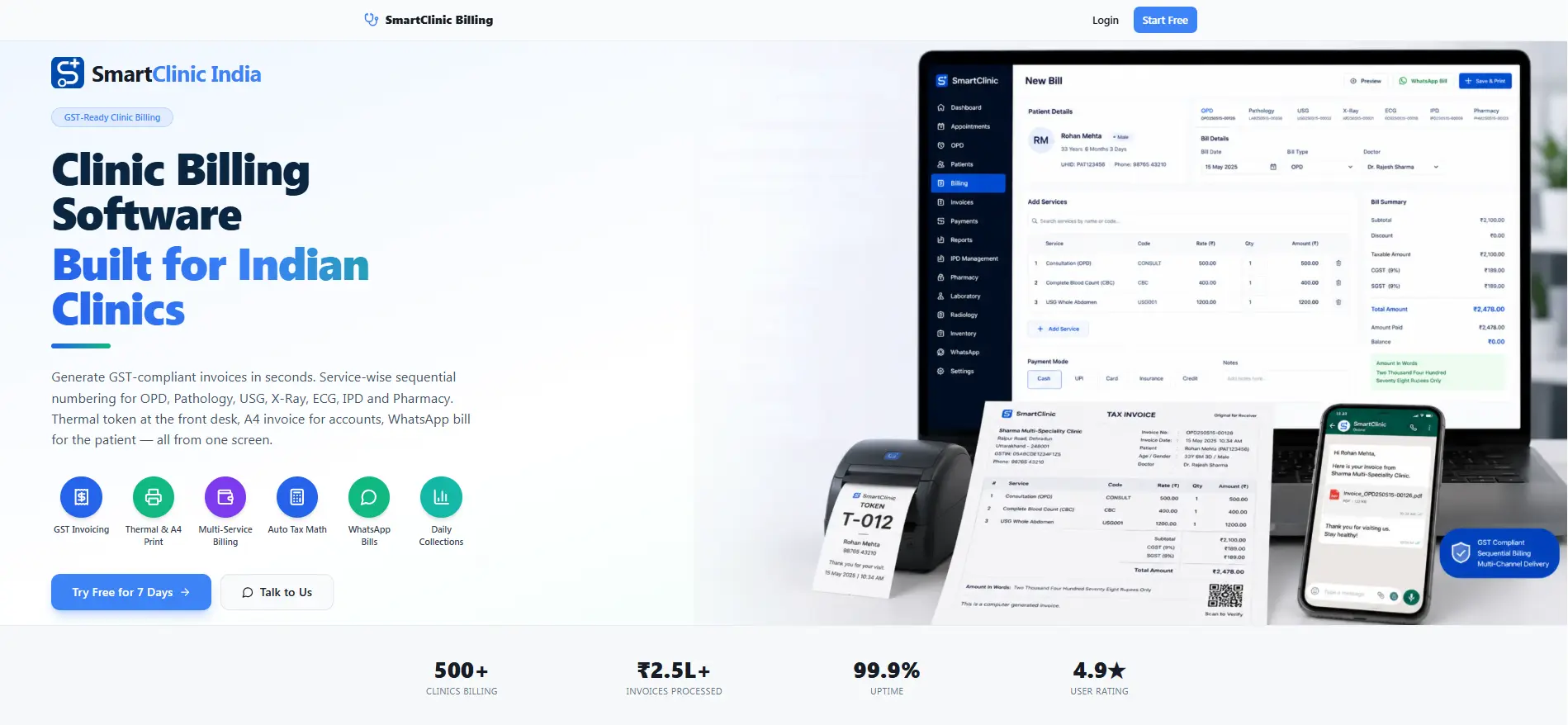
Manual receipt books and Excel sheets are no longer enough for Indian clinics. With GST 2.0 enforcement, NMC digital record requirements and patients demanding WhatsApp invoices, every clinic — solo OPD to multi-branch hospital — needs proper clinic billing software. This 2026 guide explains what to look for, how much it costs, who can use it, and which government regulations apply.
What is clinic billing software?
Clinic billing software is a cloud or desktop application that generates GST-compliant invoices, manages consultation fees, procedure charges, IPD bills, pharmacy add-ons and insurance billing — all linked to a patient record. Modern Indian solutions like SmartClinic India also handle sequential invoice numbering, doctor commission, referral payouts and prepaid wallet deductions.
Core features your clinic billing software must have
- GST invoicing with HSN/SAC codes and 18% tax breakup (CGST + SGST or IGST)
- Sequential invoice IDs per financial year — mandatory under CBIC rules
- Multiple payment modes — Cash, UPI, Card, Net banking, Insurance
- Auto WhatsApp invoice delivery with PDF and verification QR
- Doctor-wise revenue split, referral commission and TDS tracking
- Daily, monthly and FY-wise MIS reports in INR (Rs. prefix)
- Pay-per-use pricing — no per-doctor lock-in
Fees & pricing
SmartClinic India runs on a transparent pay-per-use model with an annual platform fee of ₹2,100 + 18% GST. There are no per-doctor or per-seat charges — only a small prepaid wallet deduction when a record is actually created.
| Item | Charge | Notes |
|---|---|---|
| Annual platform fee | ₹2,100 + 18% GST | One-time per year, unlimited users |
| Per OPD invoice | ₹1 | Deducted from prepaid wallet only when bill is created |
| Per IPD admission | ₹5 | Covers full admission lifecycle |
| Per pharmacy bill | ₹0.50 | For integrated pharmacy module |
| WhatsApp invoice | ₹0.85 | Optional, billed by WhatsApp BSP |
| Setup / migration | ₹0 | Free self-service signup |
All prices exclusive of 18% GST as per GST Portal of India.
Who is eligible?
- Registered Medical Practitioners (MBBS, BDS, BAMS, BHMS, BUMS) with valid NMC / state council registration
- Single-doctor clinics, polyclinics, nursing homes and hospitals
- Diagnostic centres, pathology labs, dental and IVF clinics
- Clinic chains and multi-branch groups (parent-child clinic_id supported)
- Any establishment registered under your state Clinical Establishment Act
Documents required to get started
- Medical Council Registration certificate (NMC / state council)
- Clinical Establishment Registration (state-specific, e.g. Bihar / UP / MP CEA)
- GSTIN — mandatory if annual turnover exceeds ₹20 lakh
- PAN of the proprietor / firm
- Bank account details for UPI & settlement
- Aadhaar of the owner (for KYC where applicable)
These are the documents you typically need to legally operate the establishment in India. SmartClinic India itself only needs your clinic name, owner email and mobile to sign up.
Explore SmartClinic India software
- Clinic Billing & GST Software
- Pharmacy Management Software
- Dental Clinic Software
- Pathology Lab Software
- Start a 7-day free trial · Talk to our team
Official government & regulatory links
- Goods and Services Tax (GST) Portal — invoice rules
- National Medical Commission (NMC)
- Central Board of Indirect Taxes & Customs (CBIC)
- Clinical Establishments (Registration & Regulation) Act
- Ministry of Health & Family Welfare (MoHFW)
Frequently asked questions
Is GST mandatory on clinic consultation fees in India?
No. Healthcare services by a clinical establishment, authorised medical practitioner or paramedic are exempt under Notification 12/2017-CT(R). However, GST applies on cosmetic procedures, hair transplants, room rent above ₹5,000/day, and pharmacy / consumables sold separately.
How much does clinic billing software cost in India?
SmartClinic India charges a flat ₹2,100 + 18% GST per year, plus ₹1 per OPD bill from a prepaid wallet. There are no per-seat or per-doctor fees, so a 5-doctor clinic pays the same base as a solo practitioner.
Can I issue a GST invoice without a GSTIN?
You can issue a "Bill of Supply" without a GSTIN if your turnover is under ₹20 lakh. Once you cross the threshold or want input tax credit, GSTIN registration on gst.gov.in becomes mandatory.
Does the software work offline during internet outages?
SmartClinic India is primarily cloud-based but has an offline-sync mode for billing and prescriptions. Bills created offline auto-sync once internet returns, keeping your sequential invoice numbering intact.
Is patient billing data safe and compliant with Indian law?
Yes. Data is stored on encrypted Indian-region servers, isolated per clinic with database-level Row-Level Security, and aligned with the Digital Personal Data Protection Act, 2023. Only authorised clinic staff can access records.
Final word
The right clinic billing software pays for itself within the first month by eliminating revenue leakage, automating GST and giving you clean MIS reports. Try SmartClinic India Billing free for 7 days — no credit card required.
1. Always show 18% GST explicitly
Indian patients are increasingly tax-aware. Every invoice should display three lines: Subtotal (taxable value), GST @ 18% (split into CGST 9% + SGST 9% for intra-state, or IGST 18% for inter-state), and Grand Total in Rs. Never embed GST silently inside the price. Showing it explicitly is good for compliance and good for trust.
2. Per-item HSN codes for pharmacy & consumables
For consultations, HSN/SAC codes apply at the service level. But for pharmacy sales and consumables, every single item must carry its own HSN, GST percentage and batch / expiry detail. Store HSN and GST% on the medicine master record, snapshot HSN and GST% onto every sale line at the moment of billing — never recalculate from the master afterwards — and print HSN, GST% and tax amount on each invoice line.
3. Sequential invoice numbers per service
GST law requires invoice numbers to be sequential and non-repeating. In a multi-service clinic this gets tricky because OPD, Pathology, X-Ray and Pharmacy all bill separately. The recommended pattern is one running counter per service per clinic, with clear prefixes like {PREFIX}-INV-OPD-001, {PREFIX}-INV-PATH-001, {PREFIX}-INV-XRAY-001, {PREFIX}-INV-ECG-001 and PH-0001 for Pharmacy sales. This keeps each service’s ledger clean while staying GST-compliant.
4. Editing invoices without breaking the audit trail
A GST invoice can be revised, but the original number must never disappear. Edit the invoice in-place and re-print, keep the audit log showing the old and new values, and for IPD bills of discharged patients lock financial edits entirely — only the platform admin can re-open them.
5. Financial reports for your CA
Your accountant should be able to download a month-end report with all invoices grouped by service type; taxable value, CGST, SGST, IGST and total tax collected; currency prefixed as Rs. (not the rupee Unicode symbol — many CA tools mis-render it); and doctor-wise share for revenue-sharing settlements.
6. Pay-per-use software pricing & GST
If you use a pay-per-use clinic management platform (such as Smart Clinic India), remember that the platform’s annual fee and wallet recharges are themselves subject to 18% GST. Always download the GST invoice for the platform fee and book it as a software expense.
Conclusion
GST compliance is not just about avoiding penalties — it is about giving every patient a clean, transparent bill they can trust. With the right invoice prefixes, snapshotted HSN data and explicit 18% display, your clinic stays audit-ready year round.
Run your clinic with SmartClinic India
All-in-one clinic management software with OPD, IPD, pharmacy, billing & WhatsApp automation. Free 7-day trial.
Start Free TrialRelated articles
Healthcare IT Consultant
The Smart Clinic India editorial team writes about clinic management, GST billing, pharmacy, and digital healthcare best practices for Indian clinics and hospitals.