
Free Glasgow Coma Scale (GCS) Calculator — Score, Chart & Interpretation
Calculate the Glasgow Coma Scale in seconds. Eye, Verbal and Motor scoring with instant /15 total, severity interpretation, intubated (1T) support and a printable GCS chart — free, private, no signup.
 Anil KumarHealthcare IT Consultant29 July 20267 min read
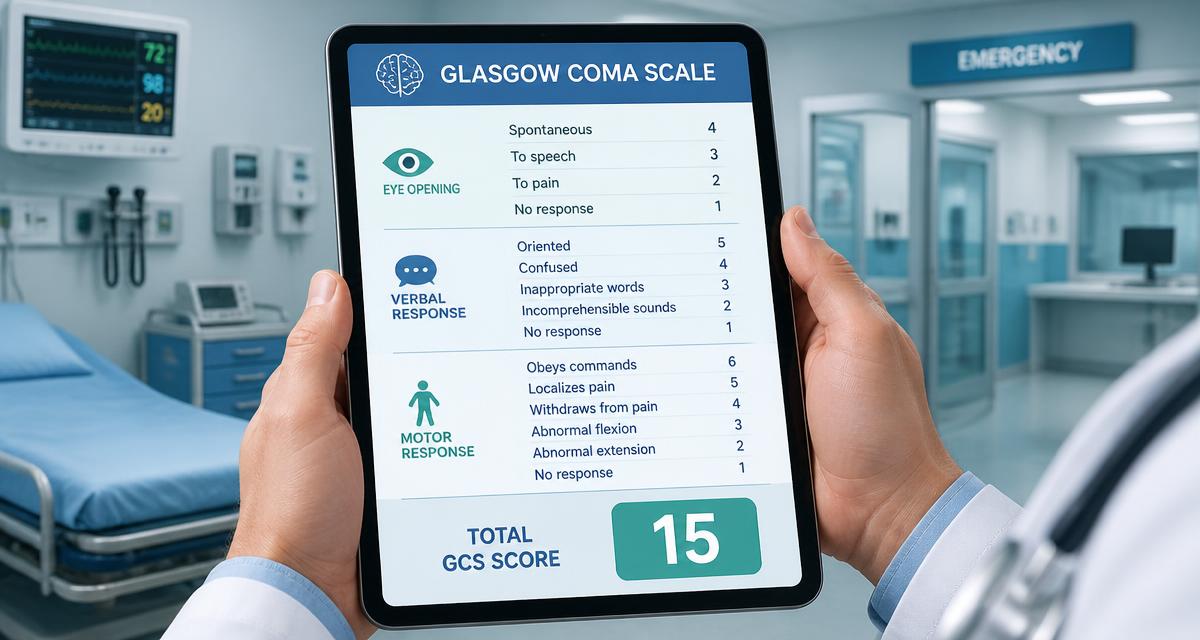
In casualty, minutes matter and the GCS is usually the first objective number written on the chart. Yet it is also the number most often miscounted — a wrong motor score changes management from observation to intubation. The Free Glasgow Coma Scale Calculator from SmartClinic India removes the mental arithmetic: tap the three responses you actually observe and get a validated score with interpretation.
👉 Open the Free GCS Calculator
What is the Glasgow Coma Scale?
The Glasgow Coma Scale (GCS) is a 15-point neurological scoring system published by Graham Teasdale and Bryan Jennett in Glasgow in 1974. It quantifies level of consciousness through three independently observed responses — Eye opening (E), Verbal response (V) and Best motor response (M). It is used worldwide in trauma, stroke, poisoning, sepsis and post-operative neuro monitoring, and it forms part of trauma scores such as RTS and TRISS.
The score is always reported as a total and its breakdown — for example GCS 11 (E3 V3 M5) — because two patients with the same total can be clinically very different.
Full GCS chart — Eye, Verbal and Motor
| Score | Eye opening (E) | Verbal response (V) | Motor response (M) |
|---|---|---|---|
| 6 | — | — | Obeys commands |
| 5 | — | Oriented | Localises pain |
| 4 | Spontaneous | Confused conversation | Withdraws from pain |
| 3 | To speech / sound | Inappropriate words | Abnormal flexion (decorticate) |
| 2 | To pressure / pain | Incomprehensible sounds | Abnormal extension (decerebrate) |
| 1 | No eye opening | No verbal response | No motor response |
Minimum total is 3 (never zero) and maximum is 15. Always record the best response observed on the best side.
How to calculate the GCS score in 3 steps
- Open the calculator — Visit smartclinicindia.com/tools/gcs-calculator on any phone, tablet or desktop.
- Tap the three observed responses — Choose one option each for Eye, Verbal and Motor. Every option carries a short clinical hint so juniors score consistently. If the patient is intubated, select the 1T verbal option.
- Read the total and interpretation — The tool shows the running total out of 15, the E/V/M breakdown and the severity band (mild, moderate or severe) with the next clinical action. Tap Copy result to paste it straight into your notes.
GCS score interpretation
| Total GCS | Severity | Typical implication |
|---|---|---|
| 13 – 15 | Mild head injury | Observation, imaging as per local head-injury criteria |
| 9 – 12 | Moderate head injury | CT head, admission and frequent neuro observations |
| 3 – 8 | Severe head injury / coma | Airway protection, neuro referral, ICU care |
A drop of 2 or more points in a serially monitored patient is a red flag and warrants immediate reassessment — trend matters more than a single reading.
Intubated, aphasic and paediatric patients
An intubated or tracheostomised patient cannot speak, so the verbal component is documented as 1T and the total is reported as, for example, GCS 7T (E2 V1T M4) — the calculator handles this automatically. For patients with severe facial swelling the eye component is marked as non-testable, and for dysphasic patients the verbal score should be interpreted with caution rather than assumed to be low consciousness. Children under 5 should be scored with the Paediatric GCS, where the verbal criteria are replaced by age-appropriate responses such as smiling, crying and consolability.
5 common GCS documentation mistakes
- Recording only the total. Always write the E/V/M breakdown — GCS 10 (E2 V3 M5) is not the same clinical picture as GCS 10 (E4 V1 M5).
- Scoring the weaker side. Use the best motor response of any limb.
- Confusing flexion withdrawal (M4) with abnormal flexion (M3). Decorticate posturing is slow, stereotyped and adducted.
- Giving V1 to an intubated patient without the "T" suffix. This makes the score look worse than the patient is.
- Not repeating the score. A single GCS is a snapshot; serial scores detect deterioration.
Who is this tool for?
- Casualty medical officers & emergency physicians — first assessment of every trauma or altered-sensorium case.
- Neurosurgeons & neurologists — pre- and post-operative consciousness monitoring.
- Intensivists & ICU nurses — hourly neuro observation charts.
- Anaesthetists — recovery-room and sedation assessment.
- Paramedics & ambulance teams — pre-hospital triage and handover.
- MBBS & nursing students — learning the scale with built-in hints.
Free GCS tool vs full clinic system
| Feature | Free GCS Tool | SmartClinic India (full) |
|---|---|---|
| Instant E/V/M score with interpretation | ✅ | ✅ |
| Save score into the patient record | — | ✅ |
| Serial GCS trend on IPD neuro chart | — | ✅ |
| Print on letterhead & WhatsApp to family | — | ✅ |
| IPD admission, billing & discharge summary | — | ✅ |
| Cost | Free | 7-day free trial |
👉 Create a free clinic account and record GCS trends inside patient files
Privacy & patient data safety
The calculator runs entirely inside your browser. No patient identifier is asked for, no score is uploaded, logged or stored on any server. Close the tab and the data is gone.
Frequently Asked Questions
What is a normal GCS score?
A fully alert, oriented patient who obeys commands scores 15 (E4 V5 M6). That is the maximum possible score.
What is the lowest possible GCS score?
3 — one point each for eye, verbal and motor. A GCS of 0 does not exist; if you see it documented, the score was recorded incorrectly.
What GCS score means coma?
A GCS of 8 or less is conventionally defined as coma, and the classic teaching is "GCS 8 — intubate", i.e. consider definitive airway protection.
How do you score GCS in an intubated patient?
Verbal is recorded as 1T and the total carries a T suffix, for example GCS 7T (E2 V1T M4). The calculator provides a dedicated intubated option.
Is the GCS calculator free?
Yes. It is completely free, requires no signup or login, and has no usage limit.
Can I use this GCS calculator on my phone in casualty?
Yes. It is fully responsive and works offline-fast on any smartphone browser — big tap targets designed for gloved hands.
Is the GCS the same for children?
No. Children under 5 should be assessed with the Paediatric GCS, which modifies the verbal criteria (smiles/coos, irritable cry, inconsolable crying, moaning, none).
How often should GCS be repeated?
In head injury, typically every 15–30 minutes initially and then hourly once stable, or per your hospital neuro-observation protocol. Any 2-point fall should trigger urgent review.
Related free tools
Run your clinic with SmartClinic India
All-in-one clinic management software with OPD, IPD, pharmacy, billing & WhatsApp automation. Free 7-day trial.
Start Free TrialRelated articles
Healthcare IT Consultant
The Smart Clinic India editorial team writes about clinic management, GST billing, pharmacy, and digital healthcare best practices for Indian clinics and hospitals.